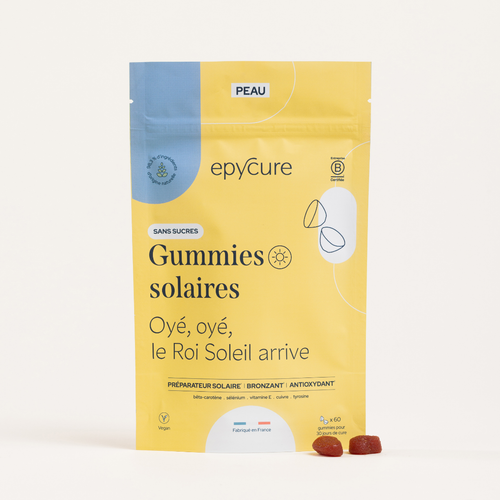
As the sunny days approach, a tan and golden skin become essential for many of us. But how can you achieve a beautiful tan while preserving your skin's health? The answer lies partly in our diet and dietary supplements. In this article, we explain how to prepare your skin for the sun from the inside, through a suitable diet and the right dietary supplements.
Understanding how tanning works
Before discussing foods and supplements that promote tanning, it is useful to understand how this mechanism works.
Melanin: the tanning pigment
Tanning is a defense response by the skin to the sun's ultraviolet (UV) rays. When the skin is exposed to UV rays, melanocytes (specialized cells found in the epidermis) produce melanin, a pigment that absorbs UV rays and gives the skin its tanned color. The more melanin the melanocytes produce, the darker the skin becomes.
The two types of UV rays
There are two types of ultraviolet rays:
- UVA rays: penetrate deep into the skin and are responsible for immediate tanning (darkening of the melanin already present). They are also associated with accelerated skin aging.
- UVB rays: remain on the surface and stimulate the production of new melanin (long-lasting tan). They are also responsible for sunburn.
Foods that promote tanning
Foods rich in beta-carotene
Beta-carotene is a natural orange-red pigment belonging to the carotenoid family. When consumed in sufficient quantities, it accumulates in the skin and gives it a slight golden tint. In addition, beta-carotene is a precursor to vitamin A, which plays an important role in the renewal of skin cells.
Foods rich in beta-carotene include:
- Carrot (the vegetable richest in beta-carotene)
- Sweet potato
- Pumpkin and squash
- Apricot
- Mango
- Melon
- Spinach and dark green leafy vegetables
To optimize beta-carotene absorption, consume these foods with a little fat (an olive oil dressing, for example), as it is fat-soluble.
Foods rich in lycopene
Lycopene is another carotenoid with powerful antioxidant properties. Studies have shown that it may help protect the skin from UV damage by neutralizing free radicals produced during sun exposure.
The main dietary sources of lycopene are:
- Tomatoes (especially cooked, as cooking increases the bioavailability of lycopene)
- Watermelon
- Pink grapefruit
- Guava
Foods rich in vitamin E
Vitamin E is a fat-soluble antioxidant that protects cell membranes from damage caused by free radicals, particularly those generated by UV exposure. It therefore helps limit sun-related skin damage and preserve the skin's elasticity.
Dietary sources rich in vitamin E include:
- Vegetable oils (sunflower oil, wheat germ oil)
- Nuts (almonds, hazelnuts)
- Seeds (sunflower seeds)
- Avocados
Foods rich in vitamin C
Vitamin C is essential for the synthesis of collagen, which maintains the skin's structure and elasticity. It also has antioxidant properties that help protect the skin from UV damage. In addition, it contributes to the regulation of melanogenesis (melanin production) and can help even out the complexion.
Foods rich in vitamin C are:
- Citrus fruits (orange, lemon, grapefruit)
- Kiwi
- Red bell pepper
- Strawberries
- Blackcurrants
- Acerola
Foods rich in zinc
Zinc plays an important role in melanin synthesis and in protecting the skin from UV damage. Zinc deficiency can affect the skin's ability to defend itself against sun exposure.
The main dietary sources of zinc are:
- Oysters (the most concentrated source)
- Red meat
- Legumes
- Pumpkin seeds
Dietary supplements to prepare your skin for the sun
Alongside a diet rich in carotenoids and antioxidants, certain dietary supplements can help prepare the skin for the sun and promote a more even and longer-lasting tan.
Beta-carotene supplements
Beta-carotene supplements are the most widely used to prepare the skin for the sun. They help increase carotenoid stores in the skin, thereby promoting a faster and more even tan. It is recommended to start the course 4 to 6 weeks before sun exposure so that the beta-carotene has time to be deposited in the skin.
At Epycure, our Sun Course contains high-quality beta-carotene, as well as other synergistic active ingredients to optimally prepare your skin for the sun.
Antioxidant supplements
Antioxidants such as vitamin C, vitamin E, selenium, and zinc help protect the skin from UV damage by neutralizing free radicals. Our Antioxidant Course combines these active ingredients for optimal cellular protection.
Mixed carotenoid supplements
Some supplements contain a blend of carotenoids (beta-carotene, lycopene, astaxanthin, lutein, etc.) for a synergistic effect on the skin. Astaxanthin, in particular, is renowned for its powerful antioxidant and photoprotective properties.
Precautions for a healthy tan
Even with a suitable diet and dietary supplements, it is essential to take precautions to protect yourself from the sun:
- Use sunscreen with a sufficient sun protection factor (minimum SPF 30, SPF 50 for fair skin or prolonged exposure).
- Avoid exposure during the hottest hours (between 12 p.m. and 4 p.m.).
- Wear protective clothing, a hat, and sunglasses.
- Stay hydrated by drinking enough water.
- Reapply sunscreen every 2 hours and after each swim.
Foods and dietary supplements that promote tanning do not replace sun protection. They complement adequate external protection; they are not a substitute.
Common misconceptions about tanning
"UV rays from tanning beds are safer than sunlight"
FALSE. Tanning beds emit mainly UVA rays, which can penetrate deeply into the skin and are associated with accelerated skin aging and an increased risk of melanoma. The World Health Organization (WHO) classifies tanning beds as carcinogenic to humans (Group 1).
"Getting sunburned at the start of the season helps you tan faster"
FALSE. Sunburn is a burn of the skin and indicates that skin cells have been damaged. Sunburn increases the long-term risk of skin cancer and can cause premature skin aging.
"Tanned skin is protected skin"
PARTIALLY TRUE. A tan provides some natural protection against UV rays (equivalent to approximately SPF 2-4 for fair skin), but this protection is insufficient to replace sunscreen.
"Eating carrots makes your skin orange"
PARTIALLY TRUE. Excessive consumption of carrots (or other foods rich in beta-carotene) can indeed give the skin an orange tint (carotenoderma). However, at the amounts usually consumed or the recommended doses for dietary supplements, this effect is not problematic and, on the contrary, helps give the skin a slightly golden complexion.
Conclusion
A beautiful tan starts from within, thanks to a diet rich in carotenoids and antioxidants and, when necessary, suitable dietary supplements. At Epycure, our formulas are specially designed to optimally prepare your skin for sun exposure and promote an even, long-lasting tan. However, remember that dietary supplements do not replace adequate sun protection: combining the two is the key to a healthy and safe tan.