A knee that creaks when climbing stairs, a stiff hip upon waking, a tense back after exertion: joint discomfort affects far more people than one might think. According to epidemiological data, more than 10 million people in France suffer from osteoarthritis, while joint pain related to intense physical activity or natural aging affects increasingly broad age groups. The good news: natural solutions exist to support joint health and restore comfortable mobility.
Understanding joint pain
A joint is a connection between two bones, held together by cartilage, ligaments, tendons, and synovial fluid. When these structures are damaged or inflamed, pain occurs.
The main causes of joint discomfort:
- Osteoarthritis: the gradual wearing down of joint cartilage, linked to aging, excess weight, or repeated microtrauma. Damaged cartilage does not regenerate spontaneously, which is why preserving and supporting this tissue is important.
- Chronic inflammation: a pro-inflammatory diet, a sedentary lifestyle, or immune factors can maintain silent inflammation in the joints, worsening pain and stiffness.
- Intense physical exertion: athletes subject their joints to repeated strain. Without suitable recovery and nutritional support, micro-injuries accumulate.
- Hormonal changes: the drop in estrogen during menopause is often associated with increased joint pain, as these hormones play a protective role in cartilage.
Symptoms vary: morning stiffness, pain during exertion, cracking, swelling, or simply a feeling of reduced flexibility. Taking action early, before irreversible damage develops, is always preferable.
Natural solutions for preserving the joints
Appropriate physical activity is paradoxically one of the best solutions for joint pain. Movement stimulates synovial fluid production, nourishes cartilage, and maintains the muscle strength that supports the joint. Low-impact activities - swimming, cycling, yoga, and Nordic walking - are particularly recommended.
An anti-inflammatory diet plays a crucial role. Reducing refined sugars, trans fats, and excess red meat while increasing omega-3s (oily fish, walnuts), colorful vegetables, and spices such as turmeric helps significantly reduce joint inflammation.
Weight management follows a simple equation: each additional kilogram places a load equivalent to 3 to 6 times its weight on the knee joints. Even a moderate loss of 5 to 10% of body weight can significantly reduce pain in people who are overweight.
Plants and natural active ingredients also offer serious options, with much better long-term tolerance profiles than synthetic anti-inflammatory drugs.
Choosing the right dietary supplements for your joints
The most extensively studied ingredients for joint comfort:
- Harpagophytum (Harpagophytum procumbens), or devil's claw, helps maintain joint flexibility. Its harpagosides inhibit several pro-inflammatory mediators, with efficacy supported by numerous clinical studies.
- Turmeric helps maintain the integrity of the joints and bones. Curcumin, its main active compound, has well-documented anti-inflammatory properties. Combining it with piperine considerably increases its bioavailability.
- Ginger helps maintain joint flexibility through its complementary anti-inflammatory properties.
- Vitamin C contributes to normal collagen formation to ensure the normal function of bones and cartilage.
- Vitamin D3 and vitamin K2 contribute to the maintenance of normal bones, which are essential to the strength of the osteoarticular system.
- Magnesium contributes to normal muscle function, supporting the muscles around the joints that protect them.
A multi-ingredient approach is particularly relevant here: the effects are synergistic and address the different dimensions of the issue (inflammation, structure, and muscle recovery).
Epycure's solution for joint comfort
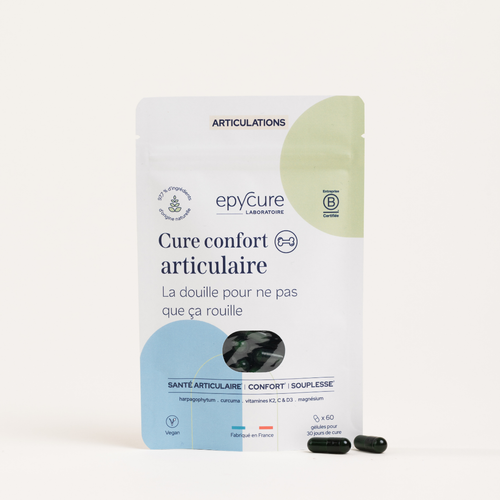
Epycure's Joint Comfort Course combines harpagophytum, turmeric, and ginger with a complete complex of vitamin C, plant-based vitamin D3, vitamin K2, magnesium, zinc, and selenium. A 97.7% natural formula designed to address every aspect of joint comfort.
In Epycure's internal studies conducted on 27 Epytesters over 2 months: 96% found the course effective, 100% reported less joint discomfort during sports, and 87% experienced increased flexibility. The first improvements are generally felt after 4 weeks of use.
For people experiencing both joint discomfort and excess weight, combining it with Metabolism Boost makes it possible to act simultaneously on joint inflammation and weight-related load reduction. A comprehensive strategy for regaining flexibility, mobility, and everyday quality of life.