You sleep for 7 or 8 hours, yet you wake up exhausted. Your nights are restless, nighttime awakenings are frequent, and sleep never seems truly restorative. This phenomenon is more common than you might think — and magnesium could well be one of the keys to addressing it.
Understanding the link between magnesium and sleep quality
Magnesium is a mineral involved in more than 300 biochemical reactions in the body. Among its many functions, it plays an essential role in regulating the nervous system and relaxing the muscles — two mechanisms directly linked to sleep quality.
When magnesium levels drop, the nervous system remains on alert. The body struggles to switch off, tension builds up, and falling asleep becomes more difficult. Nighttime awakenings become more frequent, and deep sleep phases become shorter. The result: you wake up tired, even after a full night's sleep.
In France, studies estimate that around 75% of the population does not meet the recommended daily intake of magnesium. The causes are numerous: increasingly processed diets, chronic stress that speeds up the elimination of magnesium by the kidneys, and depleted agricultural soils. Deficiency often develops quietly, without us connecting it to sleep problems.
Natural solutions for better sleep
Before considering supplements, a few everyday adjustments can make a real difference to your nights.
Focus on foods rich in magnesium: Brazil nuts, almonds, pumpkin seeds, leafy green vegetables, legumes, and cocoa. A handful of almonds as an afternoon snack already helps cover part of your needs. Also consider reducing sleep disruptors: caffeine after 2 p.m., screens in the evening, alcohol, and heavy late meals — all of these interfere with the natural production of melatonin and disrupt your sleep cycles.
Create a soothing evening ritual: a cool bedroom (18-20°C), complete darkness, and 10 minutes of reading or deep breathing to signal to your brain that it is time to switch off. Finally, manage stress during the day: a 20-minute walk, yoga, or a few heart coherence exercises can significantly lower your cortisol level at bedtime.
Choosing the right supplements for sleep
The sleep supplement market is vast — and often a source of confusion. Here are a few essential criteria to help you make the right choice.
First, the form of magnesium: magnesium oxide is poorly absorbed and poorly tolerated. Magnesium bisglycinate is preferable, as it has significantly higher bioavailability and excellent digestive tolerance. Next, consider the synergy between active ingredients: combined with plants such as valerian or adaptogens such as schisandra, magnesium's effects are amplified. These plants act on complementary mechanisms: calming the nervous system, regulating the sleep-wake cycle, and managing stress at a deeper level.
Also check the complete ingredient list to avoid unnecessary excipients (magnesium stearate, maltodextrin, artificial colorants), and plan a course of at least 3 months: sleep is a balance that is rebuilt over time.
Our Epycure solution for truly restorative nights
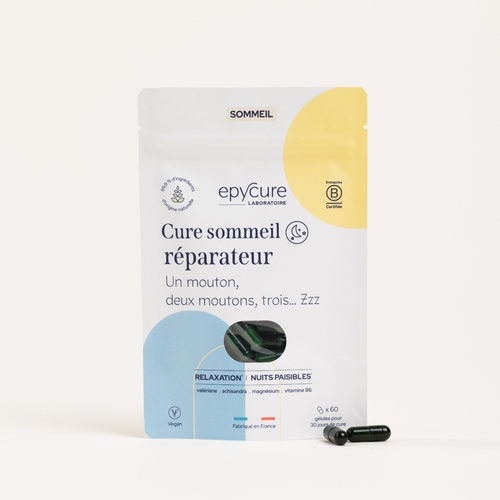
The Restorative Sleep Course was formulated by Epycure's R&D team to naturally address the underlying causes of disrupted nights, without melatonin, hormones, or the risk of dependence.
Its key ingredient is schisandra, an adaptogenic berry whose properties have been recognized for centuries in traditional Chinese medicine. It helps the body adapt better to stress — one of the most common factors behind fragmented sleep. The formula combines valerian, traditionally used to help promote sleep onset and maintain natural sleep, with magnesium bisglycinate, which contributes to the normal functioning of the nervous system, and vitamin B6, which supports normal psychological functions.
The timeline of effects is clear: from day 15, falling asleep becomes easier and nervous tension decreases. By day 30, nighttime awakenings become less frequent. After 3 months, overall sleep quality improves sustainably.
To go further, our Sleep Routine combines the Restorative Sleep Course with Fast Sleep Gummies — a complete duo designed to work both throughout the night and at bedtime, available at €79.20 for 3 months. 100% French formulation, vegan, gluten-free, lactose-free, GMO-free, ISO 22000 certified.
In summary
Magnesium is much more than an anti-cramp mineral: it is a key player in sleep, nervous system relaxation, and recovery. If your nights are not restorative despite getting enough sleep, explore this possibility — starting with your diet, then considering a well-formulated supplement. Your sleep deserves better than another night spent counting sheep.