You take a long time to fall asleep. Or you fall asleep without any problem, but wake up at 3 a.m. with a mind that is racing. Or perhaps you sleep for 7 to 8 hours and wake up exhausted. These three scenarios describe sleep disorders with different mechanisms - and different solutions. Here is what science tells us about their causes, and how to address them naturally.
The three most common types of sleep disorders
Sleep disorders are not one homogeneous group. It is important to distinguish between them in order to take effective action.
Difficulty falling asleep is often linked to overactivation of the sympathetic nervous system (the body's "alarm" mode). Cortisol remains elevated in the evening when it should be decreasing, the mind keeps going round in circles, and melatonin does not rise quickly enough. This profile is typical of people who are stressed, overworked, or who look at bright screens until bedtime.
Frequent nighttime awakenings often indicate fragmentation of deep sleep (N3 stages of slow-wave sleep). There are multiple possible causes: hormonal imbalances (particularly common during perimenopause, when declining estrogen and progesterone destabilize the sleep-wake cycle), unstable blood sugar, magnesium deficiency, or undiagnosed mild sleep apnea.
Non-restorative sleep - sleeping enough but waking up tired - points to a lack of deep sleep or REM sleep. The recovery phases are not long or deep enough to repair the body and consolidate memory.
The central role of stress in sleep disorders
Stress is involved in almost all sleep disorders. Here's why: during chronic stress, the body produces more cortisol, the hormone of wakefulness and alertness. Normally, cortisol follows a precise circadian rhythm - high in the morning, low in the evening. In cases of overwork or anxiety, this rhythm becomes disrupted: cortisol remains elevated at night, preventing sleep onset or the consolidation of deep sleep.
At the same time, serotonin (the precursor to melatonin, the sleep hormone) is disrupted. Serotonin synthesis partly depends on vitamin B6 - a deficiency in this nutrient can therefore contribute to difficulty falling asleep.
Natural solutions that have proven effective
Valerian (Valeriana officinalis) is the best-documented sleep herb in Europe. Rich in valerenic acid, it acts on GABA receptors in the brain - the same receptors targeted by certain sleeping pills, but without dependency or side effects. It is traditionally used to make it easier to fall asleep and maintain natural sleep, a claim recognized at European level.
Schisandra (Schisandra chinensis) is a thousand-year-old adaptogen used in traditional Chinese medicine. Its properties are particularly interesting for sleep: it helps the body adapt better to stress, reduces mental and physical fatigue, and promotes emotional balance conducive to peaceful nights. Studies have confirmed its effects on stress management and reducing its impact on the sleep-wake cycle.
Magnesium is the ultimate anti-stress mineral. It contributes to the normal functioning of the nervous system, supports normal psychological functions, and promotes normal muscle function. A magnesium deficiency (common among stressed people, who excrete more of it in their urine) can directly result in difficulty mentally switching off in the evening and nighttime cramps that fragment sleep.
Vitamin B6 plays a role in the synthesis of neurotransmitters that regulate the sleep-wake cycle - serotonin foremost among them, as a direct precursor to melatonin. It contributes to the normal functioning of the nervous system and normal psychological functions.
What to avoid so as not to worsen sleep disorders
Several habits weaken sleep without us always being aware of it. The blue light from screens in the evening suppresses melatonin secretion for up to 2 hours. Caffeine consumed after 2 p.m. remains active in the body for up to 8 to 10 hours afterward. Alcohol, often considered to help with falling asleep, actually fragments deep and REM sleep during the second half of the night. Intense exercise after 7 p.m. raises body temperature and cortisol levels, delaying sleep onset.
Keeping consistent bedtimes and wake-up times - even on weekends - is one of the most effective interventions for stabilizing the biological clock and improving sleep quality.
The Epycure solution: a melatonin-free, non-habit-forming formula
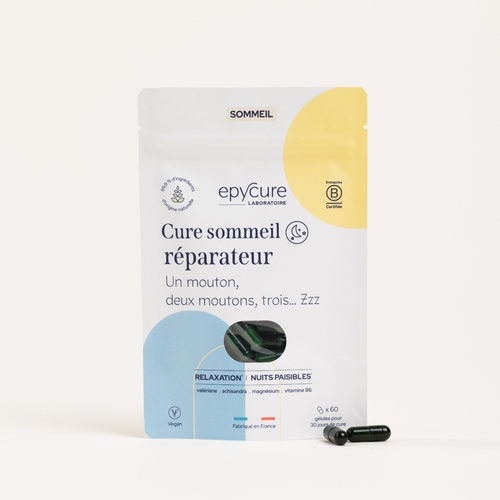
Epycure's Restorative Sleep Program meets a growing demand: regaining deep, restorative sleep without synthetic hormones, sleeping pills, or the risk of dependence.
The current formula - the Valerian + Schisandra version, made with 99.9% ingredients of natural origin - is built around this synergy:
- Schisandra chinensis: anti-stress adaptogen that reduces mental fatigue and improves sleep quality
- Valerian root (valerenic acid): acts on GABA receptors, making it easier to fall asleep and helping maintain deep sleep
- Vitamin B6: supports serotonin → melatonin synthesis
- Magnesium bisglycinate: promotes nervous system and muscle relaxation
Dosage: 2 capsules per day, 30 minutes to 1 hour before bedtime (from age 12). Do not use before an activity requiring sustained alertness. Not recommended for pregnant or breastfeeding women or in case of anticoagulant treatment.
Expected timeline of effects
- Day 15: Calmer mind in the evening, easier sleep onset
- Day 30: Fewer nighttime awakenings
- Day 90: Lasting improvement in the quality and depth of sleep
A 3-month course is recommended for lasting action on chronic sleep disorders - the time needed for biological mechanisms to recalibrate at a deeper level.
Also read in the Feel-Good Journal
Our Epycure solutions for restorative sleep
No hormones, no dependency - clinically studied natural active ingredients.
- Restorative Sleep Program - Schisandra + Valerian + Magnesium + B6, 99.9% natural
- Sleep Routine - The complete routine for peaceful nights