In 2002, an American study involving 660 people established something striking: individuals with a positive perception of aging lived an average of 7.5 years longer than pessimists. Not a slight difference - 7.5 years.
Positive thinking is not a New Age philosophy based on quotes over sunset backgrounds. It is a mental practice rooted in neurology. Repeating positive statements with conviction literally alters your brain patterns, changes your perception of the world - and, over the long term, transforms your behavior.
In practical terms, it can be cultivated. Here's how.
The 3 pillars that make it really work
Before getting into the 8 keys, there are 3 basic conditions:
Autosuggestion. Faced with a difficult situation, don't say "this is too hard" but "I can do it." Don't say "I'll try" but "I achieve my goals." The brain cannot distinguish a real fact from a convincing repetition - use that to your advantage.
Emotion. A positive statement recited mechanically is not very useful. It is by feeling it - letting joy, pride, and relief rise within you - that it becomes anchored in the subconscious.
Conviction. Step into the role. An actor who doubts does not convince anyone. Believe what you say, at least for as long as you are saying it.
The 8 keys to positive thinking
1. Speak in the first person
"I need to...", "we should..." create distance from the action. Say "I." It is more engaging, more direct, and more effective. "I take care of myself" carries more weight than "I should take better care of myself."
2. Speak in the present tense
The brain treats the past and the future as abstractions. The present, however, is real. Phrase your intentions in the present indicative: "I am calm and focused" rather than "I will be more serene someday." Limit rumination about yesterday and anxious projections about tomorrow. What you cultivate now is the only thing you truly have control over.
3. Get enough sleep
A study from Binghamton University confirms it: people who sleep well and go to bed earlier are significantly less prone to repetitive negative thoughts. A tired brain amplifies rumination and reduces emotional resilience. Respect your sleep - it is one of the most powerful ways to maintain a positive mindset.
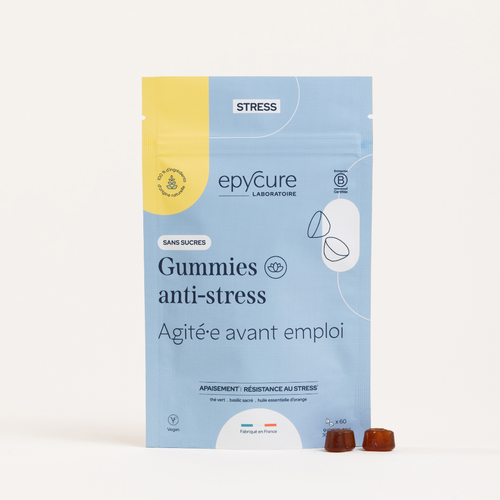
💡 If stress disrupts your ability to fall asleep, our Gummies for stress combine L-Theanine, Ashwagandha, and Saffron to help you unwind before bed.
4. Make progress, don't judge yourself
Positive thinking is not immediate perfection. Projects take shape, and so do habits. Incorporate the idea of progress into your statements: "little by little," "day by day," "at each step." Congratulate yourself on every advance, however small. A brain rewarded with satisfaction tends to repeat the behaviors that generated it.
5. Choose your circle
Positive thinking is contagious - in both directions. People who consistently bring you down drain your energy and undermine your efforts. This is not a reason to abruptly cut ties, but to gradually gain some distance. Spend more time with those who lift you up. Their optimism rubs off.
6. Visualize your "future self"
Visualization is not daydreaming. It is a technique used by top athletes and validated by neuroscience: imagining a future action activates the same brain circuits as performing it. Take 10 minutes. Close your eyes. Imagine yourself having already achieved your goal - the sensations, details, and emotions. Truly inhabit that state. Repeat regularly.
7. Cultivate gratitude
Each evening, identify 4 or 5 things from your day that you are grateful for. Not extraordinary things - a coffee enjoyed peacefully, a pleasant conversation, a task completed. Gratitude redirects the brain's attention toward what is going well rather than what is missing. With regular practice, it is one of the most effective ways to firmly establish a positive mindset over time.
8. Add a self-compassion clause
Some positive statements can create pressure if you experience them as absolute obligations. Soften them: "if this is right for me," "at my own pace," "in keeping with who I am." Positive thinking is not a demand to perform. It is a tool for your well-being.
The feel-good exercise to try tonight
Stand in front of a mirror and smile. Repeat a positive statement you have chosen out loud - three times, in three different tones: a soft voice, a normal voice, and an assertive voice.
Here are a few statements that have proven effective:
- "Every day, in every way, I'm getting better and better."
- "I make my life a dream, and my dreams a reality." - Saint-Exupéry
- "I never lose. Either I win, or I learn." - Nelson Mandela
This is not insignificant. Vocal repetition activates both the language areas and the emotional circuits - it is more effective than simply thinking about it.
In summary
Positive thinking is not something you simply declare - it is something you practice. These 8 keys do not require a revolution in your life. Just consistency, a little intention, and the conviction that your brain is far more malleable than you think.
Start with just one key. Stick with it for 3 weeks. Observe.