From the age of 25, natural collagen production decreases. The skin loses firmness and elasticity, and the first signs of aging appear.
Although collagen can be obtained through the diet, taking it as a dietary supplement - particularly in capsule or powder form - remains easier to incorporate into a balanced lifestyle.
All that remains is to determine how to choose it properly. We give you all the keys!
What is collagen? What is it used for?
Collagen is among the most abundant proteins in mammals, including humans. It is essential for the formation of tendons, cartilage, connective tissues, and skin tissues, notably ensuring skin cohesion, elasticity, and firmness while helping to delay the appearance of wrinkles and fine lines. It also plays a crucial role in numerous conditions such as osteoarthritis and osteoporosis.
A key ingredient in anti-aging creams, collagen has many benefits for combating skin aging. Medicine has shown interest in it for many years, and more recently, so has the field of nutraceuticals.
What are the different types of collagen for the skin?
There are 28 types of collagen, each with specific structures and functions. Some stand out for their properties targeting cartilage or muscles, while others act on the skin. Among them, five types are particularly widespread:
Type I collagen
Type I collagen is the best known and also the most abundant in the human body: it accounts for more than 90% of the organic mass of bones and is the primary collagen in the skin. Providing biomechanical properties such as firmness, elasticity, and skin cell renewal, it is primarily used for its anti-aging properties.
Type III collagen
A major component of the extracellular matrix that makes up our organs and skin, it is usually found in synergy with type I collagen to enhance the effects of skin elasticity and firmness.
Type V collagen
This type of collagen is the main contributor to skin cell regeneration. It is widely present on the surface of cells and in hair, as well as in the placenta, where it helps form the fetus’s skin.
Other types of collagen
Less well known than those mentioned above, there are also:
-
Type IV collagen, which contributes to the formation of the various layers of the skin.
-
Type II collagen, the main component of cartilage, plays a role in the proper functioning of the joints and helps prevent joint pain. To learn everything about joint health, we invite you to read our article “How to take care of your joints?”
Which sources provide a good supply of collagen?
Bovine collagen
This is one of the most widely used sources of collagen in industry and comes mainly from cow skin and bones. It contains type I, II and IV collagen. However, its use is controversial because animal sources could be linked to a risk of contamination by diseases such as BSE (bovine spongiform encephalopathy) or TSE (transmissible spongiform encephalopathy), which could pose a danger when consumed daily.
Bone broth
Chicken bone broth, or bone broth, which is particularly rich in collagen. Made up of type II collagen, it is considered an “equitable” source because it is obtained from by-products of the food industry. Its form provides numerous minerals which, synergistically, support hydration and skin elasticity, as well as helping to maintain joint health.
Marine collagen
Marine collagen is the most widely used source of collagen in the dietary supplement industry. Derived from fish skin or cartilage, it contains the same types of collagen as its bovine counterpart (I, II, IV), while offering high biocompatibility and low immunogenicity, making it suitable for many applications, particularly in cosmetics, for tissue repair and healing.
Vegan and vegetarian collagen
Strictly speaking, there is no “vegan” collagen, only plant-based alternatives that stimulate its production. Vegetarian collagen, on the other hand, does indeed exist: it is found in eggshell membranes, which contain large amounts of type I and V collagen, accounting for 30 to 40% of their mass.
In addition to being suitable for vegetarian diets, eggshell membrane collagen has the advantage of being just as effective as conventional collagen at lower doses, and has also demonstrated highly encouraging clinical results: +12% skin elasticity observed in a study involving 7 participants after 5 weeks. Moreover, it is notably rich in hyaluronic acid, unlike other collagen sources.
Plumper-looking skin
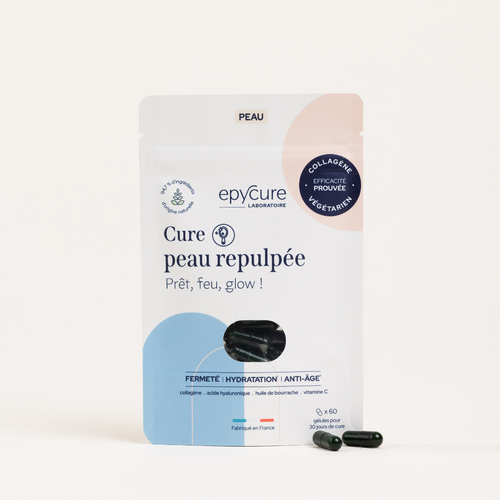
Discover this star ingredient in our formula dedicated to skin beauty, the Plumper-looking skin, made with eggshell membrane collagen - rich in hyaluronic acid and elastin - combined with vitamin C and borage oil - an outstanding anti-aging ingredient - as well as vitamins A, E, B6, biotin and zinc to limit premature skin aging and promote hydrated, fresh and plump skin.
What are the criteria for high-quality collagen?
As with many supplements on the market, not all collagen products are created equal. Due to its growing popularity in recent years, the quality of some formulas is sometimes compromised in favor of financial considerations. That is why it is essential to consider certain criteria when choosing high-quality collagen.
Origin of collagen
Whether the collagen is of animal or plant origin, traceability is essential for transparency and helps ensure its naturalness and origin, including the animals’ farming methods and fishing practices. In this case, choose marine collagen from responsible fishing (MSC Sustainable Fishing label).
Absorption & bioavailability
Naturally occurring collagen molecules are not well absorbed by the body. Its absorption is improved through prior hydrolysis, which breaks it down into small pieces of collagen called "collagen peptides" or "hydrolyzed collagen", thereby enabling better absorption due to their lower molecular weight than raw collagen.
Dosage criteria
“It’s all about dosage.”
The collagen dosage depends on the goal to be achieved. For beneficial effects on the skin, a daily dose of between 2.5 g and 5 g of marine collagen is recommended for optimal hydration and to maintain skin elasticity. A higher intake, from 10g to 20g per day, has shown beneficial effects on joint health, muscle mass, and bone health.
Although collagen is not considered dangerous, health recommendations advise not exceeding 20g of collagen per day.
And what about the importance of diet?
They say that diet is the foundation of good health and well-being. And it's true! Here are some foods that help naturally boost collagen production:
Lean meats and fish
Considered the richest source of amino acids, they provide proline and lysine, which are essential for collagen formation.
Eggs
Thanks to their high amino acid content, they provide large amounts of proline, an amino acid that ensures collagen synthesis and strength. Eggs are also a good source of glycine, the most abundant amino acid in collagen, which, in synergy with proline, helps increase skin collagen synthesis.
Avocado
Rich in vitamin E, it slows premature skin aging by preventing age-related collagen loss.
Vitamin C
Naturally present in many fruits such as kiwi, orange, and strawberries, as well as in green vegetables, vitamin C helps boost collagen production through its action on the enzymes responsible for its biosynthesis. It is also often combined with collagen to optimize its effects and promote its absorption.
Vitamin A
This vitamin is known for its role in wound healing. It is also involved in collagen formation through its effect on its specific enzyme, collagenase.
Ginseng
An adaptogenic plant, ginseng is also beneficial for preventing collagen breakdown thanks to its antioxidant properties, helping protect the skin against damage caused by UV rays, as well as the body against oxidative stress.
📚 You may also like
✨ Our Epycure solutions