Multivitamins: why take them, how to choose one, and who really needs them
Multivitamins are the best-selling dietary supplements in the world. But their reputation is polarized: some consider them universal nutritional insurance, while others deem them unnecessary for those who eat a balanced diet. The truth is more nuanced — and worth examining.
Why even a «balanced» diet is not always enough
The idea that the modern diet meets all nutritional needs is a deeply rooted myth, but epidemiological data tell a different story.
In France, ANSES studies show concerning deficiencies in the general population: 80% of French people have insufficient vitamin D intake, 70% are deficient in magnesium, and deficiencies in vitamin B12, zinc, and selenium have been documented in certain populations.
Why? Several factors:
Depleted soil: intensive farming practices have reduced the mineral content of arable land. Today's foods contain significantly less magnesium, zinc, and selenium than they did 50 years ago.
Food processing: industrial processes (cooking, refining, preservation) destroy some vitamins and micronutrients.
Vitamin D: synthesized primarily through sun exposure, it is insufficient in most people living at northern latitudes (including France) during the months with little sunlight.
Modern lifestyles: chronic stress depletes magnesium, vitamin C, and B vitamins at rates that are difficult for the diet to compensate for. Smoking destroys vitamin C. Alcohol disrupts the absorption of B vitamins. Certain medications reduce absorption or increase the loss of specific micronutrients.
The key ingredients in a well-formulated multivitamin
B vitamins (B1, B2, B3, B5, B6, B9, B12)
B vitamins contribute to energy production, nerve signal transmission, and cell renewal. B9 (folate) and B12 deserve particular attention among vegans and vegetarians (B12 is virtually absent from plant foods). Vitamins B1, B3, B6, B9, and B12 contribute to the normal functioning of the nervous system and normal psychological functions.
Vitamin D3
Vitamin D3 (cholecalciferol) contributes to the normal functioning of the immune system, the maintenance of normal bones, and proper calcium absorption. Its presence in a multivitamin is almost universally justified in temperate Europe.
Iron
Iron is the central component of hemoglobin. It contributes to the normal transport of oxygen in the body and helps reduce fatigue. Particularly important for women, vegetarians, and athletes.
Vitamin C
In addition to its antioxidant properties and support for the immune system, vitamin C improves the absorption of non-heme iron. It also helps reduce fatigue.
Magnesium
Magnesium helps maintain normal psychological functions and reduce fatigue. It is one of the minerals most commonly deficient in the French population.
Zinc and selenium
These two trace elements contribute to the normal functioning of the immune system and help protect cells from oxidative stress. Two essential defenses in modern everyday life.
Who really needs a multivitamin?
Almost systematically:
- Vegans or vegetarians (risk of B12, iron, and zinc deficiency)
- Pregnant women or women planning a pregnancy (folate, iron, iodine, vitamin D)
- People aged 65 and over (reduced absorption, less sun exposure)
- People taking interacting medications (the pill, PPIs, metformin, statins…)
Very often justified:
- People under chronic stress
- Intense athletes
- People living in areas with little sunlight or spending little time outdoors
What distinguishes a good multivitamin from a bad one
Avoid: formulas with dozens of ingredients in tiny doses. An active ingredient's effectiveness depends on its dose. Fewer ingredients at relevant doses are better.
Prefer: bioavailable forms of the active ingredients, doses aligned with recommendations, complete traceability, and manufacturing in France.
Check for: the absence of synthetic colorings, artificial flavors, and unnecessary excipients such as maltodextrin or magnesium stearate.
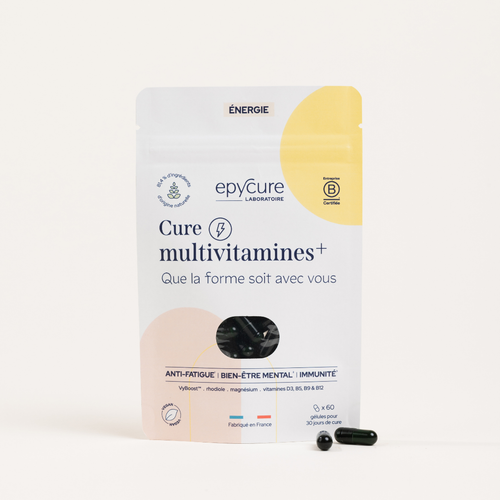
The Epycure Multivitamin+ Course: much more than a classic multivitamin
The Multivitamin+ Course is not just a simple multi-ingredient formula. Its key ingredient is rhodiola (Rhodiola rosea), an adaptogenic plant used for centuries in traditional medicine and scientifically documented to reduce nervous fatigue associated with excessive mental strain, improve cognitive clarity, and regulate cortisol levels.
This rhodiola is combined with 13 essential micronutrients: B vitamins (B1, B2, B3, B5, B6, B9, B12) for energy and the nervous system, vitamin D3 (extracted from lichen — vegan), iron + vitamin C (reducing fatigue and transporting oxygen), magnesium (nervous system balance), zinc and selenium (immunity and cellular protection), plus spirulina for its plant-based protein, mineral, and antioxidant content.
Designed for vegetarians and vegans (plant-based capsules, active B12, plant-based vitamin D3). Just 2 capsules/day are needed — whereas other formulas require 4 or more.
Lab'Epycure results: 97% feel in better physical and mental shape after 3 months, and 1 in 2 feel less overwhelmed after just 30 days.
Key takeaways
Multivitamins do not replace a balanced diet — but in everyday life, they fill real gaps that diet alone does not always correct. A good multivitamin goes beyond the bare minimum: adaptogenic ingredients such as rhodiola can transform a basic formula into a true daily vitality booster.
Food supplements. Not recommended for anyone under 18 or for pregnant or breastfeeding women. If you are taking medication, consult your doctor before starting supplementation.
📚 Also worth reading
- → Chronic fatigue: the best supplements for getting your energy back
- → Chronic stress: causes, signs, and natural solutions
- → Dietary supplements during pregnancy
✨ Our Epycure solutions