Your joints play a crucial role throughout your life. Whether you have a sedentary or active lifestyle, your joints are always in use. Angélique provides you with information about the link between joint problems and the gut ecosystem.
1. An overview of intestinal toxins
New hypotheses suggest several links between this pain and the state of the gut flora. The latter is more or less permeable, and it could allow certain types of toxins to pass through it. When undigested elements enter the bloodstream, our body's immune system detects them and activates its natural defenses. These defenses then seek to eliminate the toxins. To do this, the antibody will, in a way, unite with the antigen. This union will give rise to a complex that will continue circulating throughout the body. As it travels through the bloodstream, this cellular complex may lodge in certain parts of the body, including the joints, and cause pain.
2. The link with joint pain
Other studies have been conducted to prove the existence of a link between the intestines and the joints. This was already the case in the 20th century, when studies established a link between joint pain and the gut ecosystem. The theory is as follows: an imbalance in the gut ecosystem can lead to the development of an infection. Because of their sensitivity, the joints react to these infections; this results in pain in the other joints.
The link between diet and the joints also concerns the nature of your diet. It has been proven that a diet that is too acidifying and rich in fat and sugar can lead to joint pain.
How can you recognize joint pain?
Muscle pain can appear during exercise: when it is injured, the muscle will only react when it is stimulated. At rest, you will feel little or no pain. Muscle pain makes it very difficult to move the injured limb (a diagnosis made by X-ray) for a period that varies depending on the severity of the trauma. This can last a few seconds in the case of a cramp, or from morning stiffness to several months in the case of a strain or muscle tear. To relieve the pain, you can see your doctor so that they can perform a massage and ease the pain.
Here are the different types of joint pain, often related to trauma.
- Osteoarthritis: osteoarthritis is a rheumatic condition that affects the joints. Osteoarthritis is caused by the destruction of the cartilage located at the ends of the bones forming the joint.
- Arthritis: arthritis is an acute or chronic inflammation of the joints. It does not refer to the condition known as osteoarthritis, but rather to a clinical sign associated with numerous joint diseases.
- Arthralgia: arthralgia is a condition characterized by pain and inflammation of a joint and the surrounding tissue.
How can you relieve joint pain?
Physical activity is associated with a greater volume of cartilage. In addition, it strengthens the muscles and bones, thereby preventing joint degeneration. Movement also releases a lubricating protein into the synovial fluid that protects the cartilage. As always, be mindful of the amount. Overtraining and, above all, the accumulation of injuries can accelerate cartilage damage. So listen to your body's signals.
Beyond physical activity, there are natural ingredients you can rely on to relieve your joints.
- Nettle leaves have been used since antiquity for their known benefits for joint mobility and flexibility.
- Turmeric, ginger, and flax also help relieve joint pain and have anti-inflammatory properties.
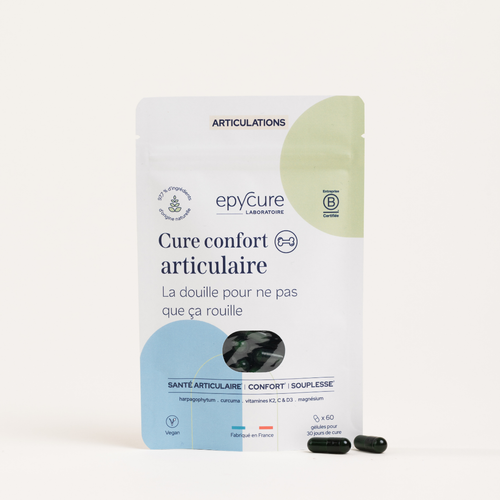
- Harpagophytum is a plant nicknamed devil's claw. It is often used in traditional medicine. Highly appreciated by athletes, it effectively relieves minor joint pain. You can find it in our personalized programs.
To find out exactly what you need, come and complete our questionnaire. It will tell you precisely which vitamins, minerals, and plants you need.
📚 Read also
✨ Our Epycure solutions